The commercial drone and Unmanned Aerial Vehicle (UAV) market is moving fast. Startups and mid-sized engineering firms are designing specialized drones for agricultural thermal imaging, autonomous search-and-rescue, and last-mile delivery.
In UAV engineering, every gram of weight directly dictates battery life and flight time. Yet, these aerial platforms must withstand intense structural vibrations, high wind loads, and rough landings. To balance this strict weight-to-strength ratio, developers cannot rely on standard off-the-shelf components. They require custom, precision CNC machining.
Here is why custom machining is critical for the evolving commercial UAV sector, and how agile resource management helps mid-sized drone developers get to market faster.
1. Complex Multi-Axis Geometry for Camera Gimbals & Sensor Mounts
Modern commercial drones carry highly sensitive payloads, including LiDAR scanners, multispectral cameras, and thermal sensors. Keeping these instruments perfectly stable during flight requires high-precision, multi-axis custom camera gimbals.
Thin Walls, Zero Play: Gimbal brackets and arms are frequently machined from aerospace-grade aluminum (such as 7075-T6) down to wall thicknesses of less than 1.5mm. Any microscopic geometric variance or "play" in the pivot joints will cause visible camera jitter.
Intricate Internal Routing: To protect delicate wiring from weather and aerodynamics, custom gimbal parts often feature complex internal cable routing paths that can only be achieved via 4-axis or 5-axis CNC milling.
2. High-Performance Engineered Plastics for Weight Optimization
While aluminum is crucial for structural joints, drone designers frequently swap metals for advanced engineering plastics in non-load-bearing components to shave off critical grams.
Machining parts from plastics like PEEK, Delrin (POM), or Carbon-Filled Nylon requires highly specialized machining techniques compared to metal:
Thermal Control: Plastics expand rapidly when exposed to tool friction heat. Machining facilities must use razor-sharp cutting geometries and exact feed rates to prevent the material from melting or deforming out of tolerance.
Rigid Structural Mounts: Main structural blocks, battery locking clips, and landing gear connectors machined from Delrin offer excellent impact absorption and high fatigue resistance without the weight penalty of steel or heavy alloys.
3. Solving the Prototypying-to-Production Bottleneck for Mid-Sized UAV Firms
Because drone technology iterates rapidly based on software and battery advancements, committing to rigid injection molds early in the design phase is incredibly risky. If a sensor shape changes, an expensive tool becomes obsolete overnight. Custom CNC machining offers the ultimate design flexibility—letting engineers modify a CAD file and cut an updated aluminum bracket in days.
However, mid-sized UAV startups face a unique challenge: scale. Traditional large-scale manufacturers ignore low-volume prototyping orders, while small, local machine shops lack the diverse machinery to handle carbon fiber, PEEK plastics, and aluminum simultaneously.
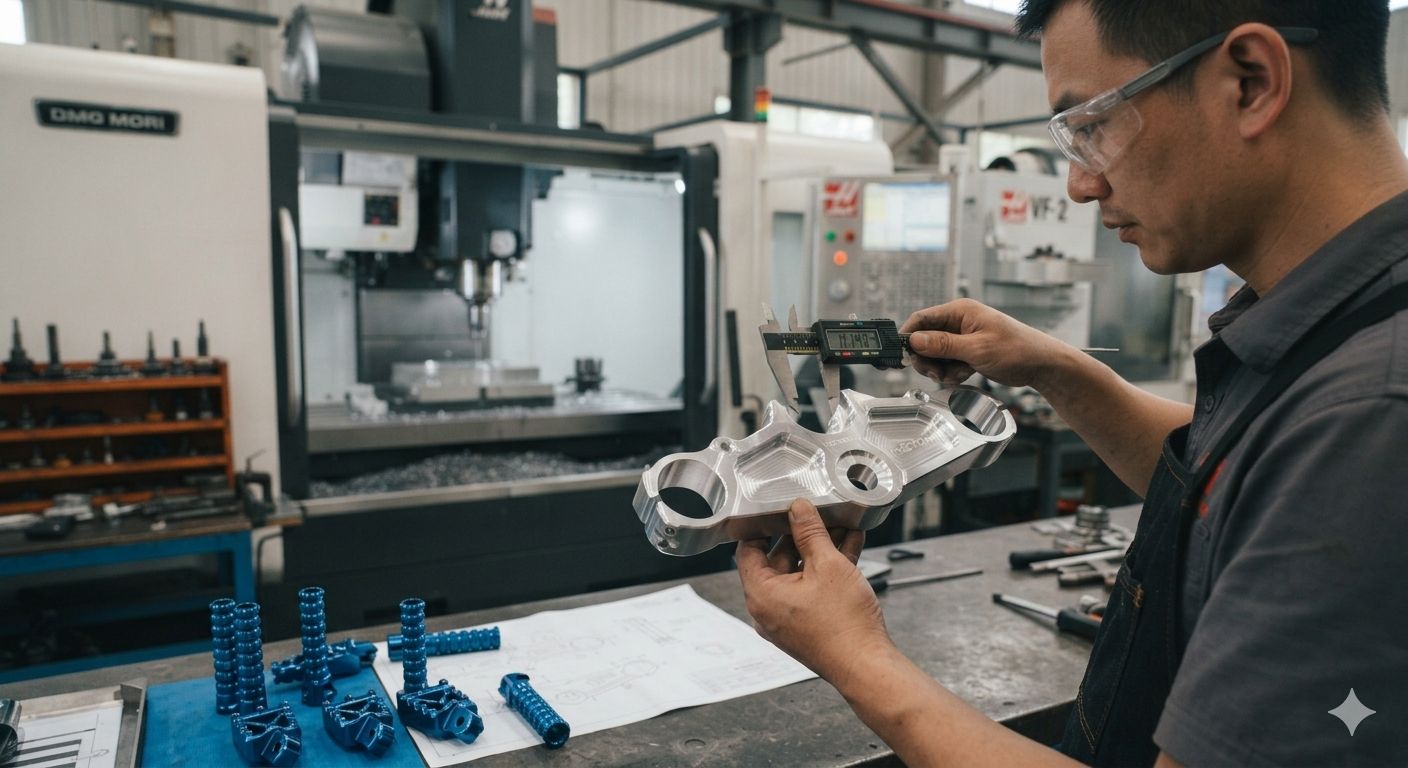
This is exactly where an on-demand manufacturing network changes the game. Instead of relying on a single vendor, drone developers can leverage a managed resource ecosystem. A dedicated engineering partner handles the design for manufacturability (DFM) review, routes the aluminum components to a high-precision milling partner, sends the PEEK housings to a plastic specialist, and manages centralized dimensional inspection reports before shipping. This unified management approach gives mid-sized drone innovators the manufacturing speed and agility they need to dominate the sky.