Forged Surgical Instruments vs. MIM: Which Manufacturing Process Is Better?
Surgical instruments have traditionally been produced using processes such as forging, machining, grinding and polishing. But as instrument designs become smaller and more complex, Metal Injection Molding (MIM) has become an increasingly interesting manufacturing option.
This raises a practical question for medical-device companies:
Should a surgical instrument be forged and machined, or can MIM produce the component more efficiently?
There is no universal answer.
Forging can provide excellent mechanical properties and is well suited to many instruments that experience significant mechanical loads. MIM, on the other hand, can be highly attractive for small, complex components where conventional manufacturing would require multiple machining and finishing operations.
The right choice depends on the instrument geometry, material, production volume, tolerances, finishing requirements and overall manufacturing cost.
Forging and MIM are fundamentally different manufacturing routes
A forged surgical instrument generally starts with stainless-steel bar or another suitable metal stock. The material is heated and formed under high pressure using dies.
The forged blank is then subjected to operations such as trimming, heat treatment, CNC machining, grinding, polishing and passivation.
MIM takes a different route.
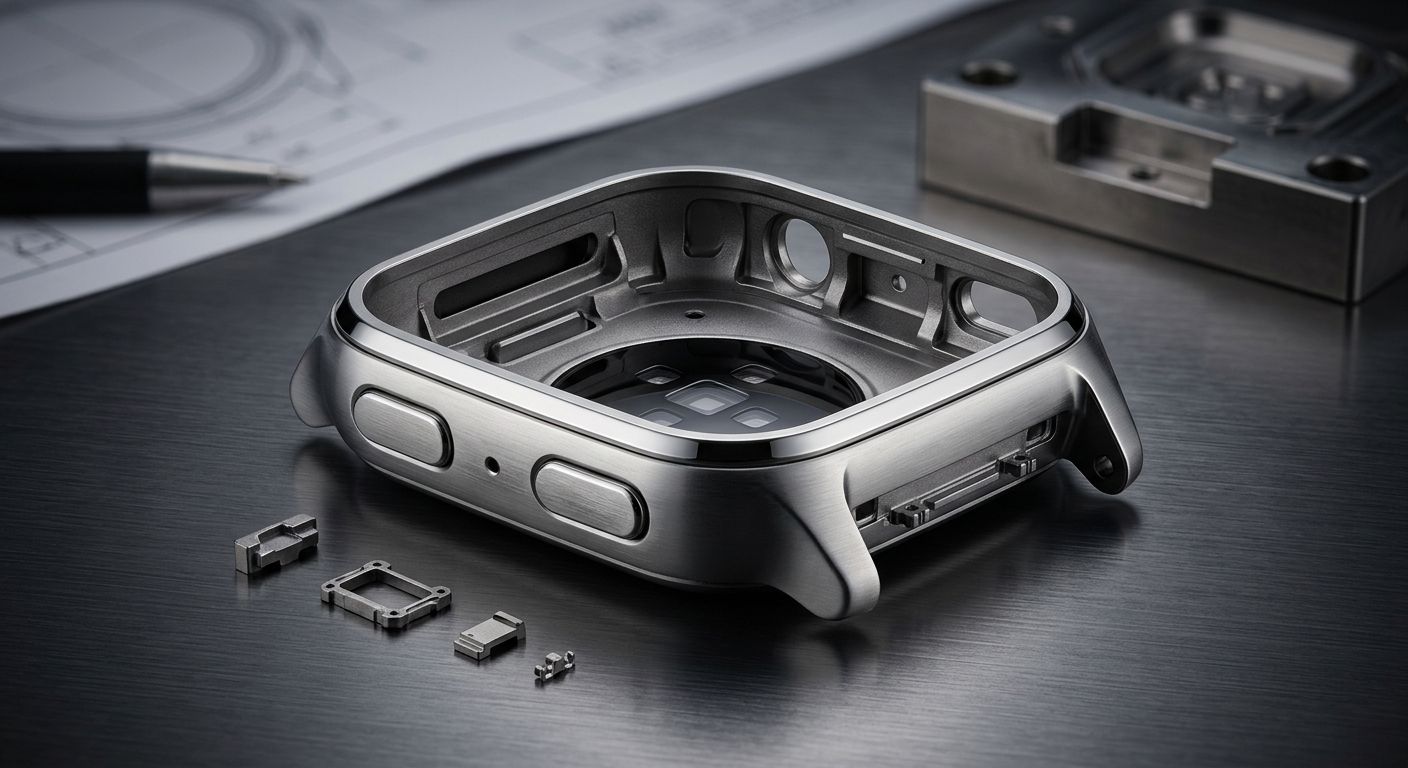
Fine metal powder is combined with a binder system to produce a feedstock. The feedstock is injection moulded using a mould that contains the required geometry. The moulded "green" component then undergoes debinding and sintering.
During sintering, the component undergoes significant shrinkage and reaches its final density and dimensions.
Secondary machining, grinding, polishing or other finishing operations may still be required for critical features.
So the real comparison is not simply:
Forging vs. MIM
It is more accurately:
Forging → machining → grinding → polishing → finishing
versus:
MIM → debinding → sintering → secondary machining/finishing → polishing
The finished cost and performance need to be considered across the complete process chain.
1. Kerrison Rongeurs
Kerrison rongeurs are a particularly interesting example because they combine relatively small dimensions with demanding functional requirements.
They are used to remove small amounts of bone, particularly in neurosurgical and spinal procedures. The cutting mechanism needs to operate smoothly, the jaws need to align correctly and the instrument must withstand repeated mechanical loading and sterilization.
For a conventional Kerrison rongeur, forging and machining can be an attractive route because the instrument requires strong functional components and several critical surfaces may need precise machining and grinding.
The manufacturing process can include forging the basic geometry, heat treatment, CNC machining of functional areas, grinding the cutting surfaces and polishing the finished instrument.
MIM could become interesting for certain smaller or more complex Kerrison components where several features can be integrated into the moulded geometry.
However, the decision should not be made simply because MIM reduces machining.
Critical cutting or mating surfaces may still require secondary operations. The dimensional changes occurring during debinding and sintering must also be controlled carefully.
For an instrument such as a Kerrison rongeur, the question is therefore not whether MIM is technically possible. The better question is whether MIM provides a reliable economic and engineering advantage for the particular geometry and production volume.
2. Surgical Scissors
Surgical scissors are another familiar example.
The blades need to meet accurately and maintain the required cutting performance. The handles, pivot area and blade geometry all influence the final function.
Forging is well suited to producing strong blanks for many scissors components. The forged parts can subsequently be machined, ground and polished to achieve the required geometry.
MIM can be attractive for smaller components or complex handle geometries where several features can be produced in one moulding operation.
However, cutting edges are a special case.
A surgical cutting edge normally requires highly controlled grinding and finishing. It would be unrealistic to assume that the MIM mould alone will produce the final cutting edge.
This illustrates an important point:
MIM is often a near-net-shape process, not necessarily a complete replacement for every secondary operation.
The right process may therefore be a combination of MIM and precision finishing.
3. Surgical Forceps
Forceps are produced in many different forms, from simple tissue forceps to more complicated instruments with fine gripping features.
A forged construction can provide a strong base for instruments that are repeatedly handled and sterilized.
MIM becomes more interesting when the forceps or a component contains small, intricate features that would otherwise require extensive CNC machining.
For example, if several small features can be incorporated directly into the mould cavity, MIM may reduce machining time and material waste.
But dimensional control remains important.
The gripping surfaces must meet correctly. Small dimensional differences can affect how the instrument holds tissue or other material.
For high-volume production, consistent cavity-to-cavity performance becomes particularly important.
4. Needle Holders
Needle holders are another good example of an instrument where the manufacturing process has to balance strength, precision and surface finish.
The jaws need to maintain the required grip on the needle. The hinge or pivot must operate smoothly, while the handle and locking mechanism need to withstand repeated use.
Forging provides a strong starting geometry, after which machining, grinding and finishing can establish the critical functional surfaces.
MIM can be considered when the component contains complicated small features or when production volume is high enough to justify dedicated tooling.
Again, the decision depends on the actual design.
If a large proportion of the final geometry still requires machining after MIM, the expected cost advantage may disappear.
5. Bone Rongeurs and Bone Punches
Bone rongeurs and bone punches place considerable mechanical demands on their working areas.
The jaws or cutting surfaces need to withstand repeated loading without unacceptable deformation or damage.
For such instruments, material properties and heat treatment become important considerations.
Forging can be attractive where the mechanical requirements are high and the geometry is reasonably compatible with a forged blank.
MIM can still have a role in smaller or more complicated components, particularly when the geometry would otherwise require extensive machining.
But the material specification and sintering process need to be carefully controlled. A medical-device manufacturer should evaluate the complete mechanical and corrosion requirements rather than selecting a process based purely on tooling cost.
6. Strength: Is Forging Always Better?
This is one area where oversimplification can lead to a misleading comparison.
It is common to hear that forged parts are automatically stronger than MIM parts.
The reality is more complicated.
Forging can provide favorable grain flow and excellent mechanical properties when the alloy and forging process are properly selected. This can make forging particularly attractive for components subjected to significant mechanical loading.
MIM components can also achieve high density and good mechanical properties when the powder, binder system, moulding, debinding and sintering processes are properly controlled.
The important question is therefore:
What mechanical properties does the finished instrument actually require, and can the selected process reliably achieve them?
For a highly loaded surgical component, forging may have a clear advantage.
For a small, intricate component where the loads are more moderate, MIM may provide a better balance between geometry, production rate and cost.
7. MIM's biggest advantage: complex geometry
This is where MIM can become particularly attractive.
Imagine a small surgical component containing several bosses, ribs, holes, curved surfaces and integrated features.
With conventional manufacturing, producing these features may require several CNC setups, special tooling and considerable material removal.
MIM can potentially produce many of these features directly in the mould.
That does not mean every feature will be perfect straight out of the mould. Critical dimensions may still require machining.
But reducing the amount of material that needs to be removed can significantly change the economics of the component.
This is particularly relevant for small, complex components produced in large quantities.
8. Material utilization
Forging starts with a piece of material that is larger than the finished component.
The forging operation itself may generate flash, followed by additional material removal during machining.
MIM starts with a feedstock that is injected into a mould and produces a component much closer to its final shape.
This can reduce material waste for suitable geometries.
However, MIM has its own costs. Feedstock preparation, moulding, debinding, sintering and process control all need to be considered.
Therefore, saying that MIM is simply "less wasteful" is not enough.
The correct comparison is the total material and processing cost per finished component.
9. Dimensional accuracy and shrinkage
This is one of the most important differences between the two processes.
With forging and machining, critical dimensions can often be established through CNC machining and grinding after the forging operation.
MIM introduces another variable: sintering shrinkage.
The moulded component is deliberately designed to be larger than the final component because the part shrinks during sintering.
The amount of shrinkage and potential distortion need to be understood and controlled.
This makes MIM tooling particularly important.
A good MIM mould is not simply a scaled-up version of the finished CAD model. The tooling and process must account for material behaviour throughout moulding, debinding and sintering.
For critical surgical interfaces, secondary machining may still be the preferred approach.
10. Surface finish matters enormously in surgical instruments
A surgical instrument does not finish its manufacturing journey when it leaves the mould or forging die.
Grinding, polishing and passivation can be critical parts of the final process.
The required surface condition can affect cleaning, corrosion resistance, appearance and overall usability.
Forged components commonly require substantial grinding and polishing.
MIM components may have a relatively good as-sintered surface, depending on the mould, material and process, but premium surgical surfaces may still require additional finishing.
This is another reason why comparing only the primary manufacturing process can give the wrong answer.
The finished instrument—not the unfinished component—is what matters.
11. Production volume changes the economics
This is probably the biggest commercial difference between forging and MIM.
MIM requires dedicated tooling, and that tooling represents an upfront investment.
For a small production quantity, it may be difficult to justify that investment.
Forging combined with machining may be more economical when production volumes are relatively low or when the component requires substantial secondary machining regardless of the primary process.
As production volume increases, the economics can change.
The cost of the MIM tooling can be distributed across a much larger number of components, while the reduction in machining time and material removal can become increasingly valuable.
This makes MIM particularly interesting for small, complex, high-volume components.
12. MIM does not eliminate CNC machining
This is an important point for product developers considering MIM.
MIM can reduce machining significantly, but it does not necessarily eliminate it.
Critical holes, mating surfaces, threads, cutting features or other tight-tolerance areas may still need CNC machining, grinding or other finishing operations.
The best design approach is therefore to decide early which features should be produced in the MIM process and which features should be finished afterward.
Trying to force every feature into the mould can make the tooling unnecessarily complicated.
On the other hand, machining every feature defeats much of the potential advantage of MIM.
The best result usually comes from finding the right balance.
13. Which process should you choose?
There is no single answer for every surgical instrument.
Forging is generally attractive when the component requires high mechanical strength, has a geometry well suited to forging, and the required production volume does not justify a more complex MIM tooling investment.
MIM becomes particularly attractive when the component is small, geometrically complex, produced in significant quantities, and contains features that would otherwise require multiple machining operations.
A third possibility is often overlooked:
Use a hybrid manufacturing route.
A component can be produced using one process and then finished using another.
For example, a forged blank may be CNC machined and ground in critical areas. Similarly, an MIM component may be produced near-net-shape and then CNC machined or ground only where tight tolerances or functional surfaces require it.
The best manufacturing process is the one that produces the required finished component reliably at the required volume and total cost.
Choosing the manufacturing process before choosing the supplier
For medical-device companies, the manufacturing process should be established before selecting a supplier purely on price.
Start with the product requirements.
What material is required?
What mechanical loads will the instrument experience?
What are the critical tolerances?
Which surfaces are functional?
What surface finish is required?
How many components will be produced each year?
Which features can be near-net-shape?
Which features require machining?
What heat treatment is required?
What corrosion resistance is required?
What inspection and documentation will be needed?
Once these questions are understood, the appropriate manufacturing route becomes much easier to evaluate.
Only then does supplier selection become meaningful.
Forging vs. MIM: The practical conclusion
Forging remains an excellent manufacturing process for many surgical instruments, particularly where strength, toughness and robust mechanical performance are important.
MIM offers a different set of advantages. For small, intricate components produced at sufficiently high volumes, it can reduce machining, improve material utilization and allow complex features to be integrated into the component geometry.
Neither process should automatically be considered superior.
A Kerrison rongeur may require a very different manufacturing strategy from a small MIM surgical component. The same applies to surgical scissors, forceps, needle holders and bone rongeurs.
The important question is not:
“Is forging better than MIM?”
It is:
“Which manufacturing route gives this particular surgical component the required mechanical performance, dimensional control, surface quality, production volume and total cost?”
That decision should be made before committing to tooling.
At HongYing, we help customers evaluate manufacturing routes, communicate technical requirements with qualified manufacturing partners and coordinate tooling and production projects in China. For complex medical components, the goal is not simply to find a factory that can make the drawing. It is to find the manufacturing route and partner that make sense for the finished product.
Exceptional parts start with choosing the right partner—not just the right factory.